“Circus can’t just be beautiful. It has to be weird. It has to be frightening.”
E. S. Martin
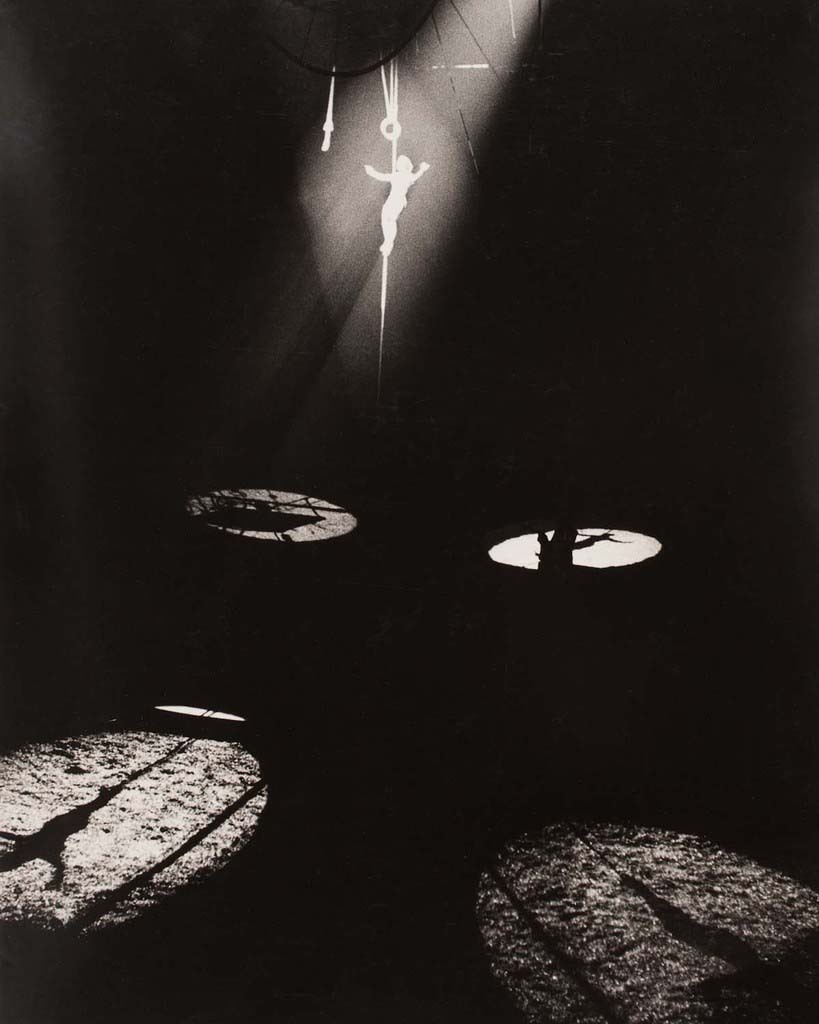
Circus sequence, NY. Lisette Model, 1950
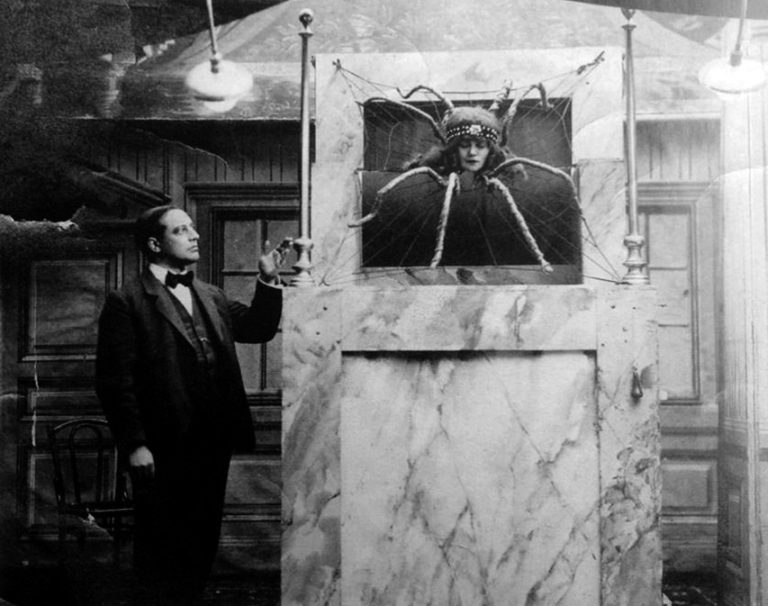
Emmy Hennings. On stage as “truth-speaking” spider. 1915.
The Trained Particles Circus proposes an improbable, precarious and potentially dangerous meeting place caged between the real and the virtual. It’s embodied in the relationship between a synthetic biomechanics and an automaton, recreating the figure of the circus artist, the puppet with its own life or the fantastic animal. And it places us as spectators to a contemporary spectacle of hybrid and augmented subjects that weaves light and shadow, fake and magic, virtual and physical reality, machine and organism.
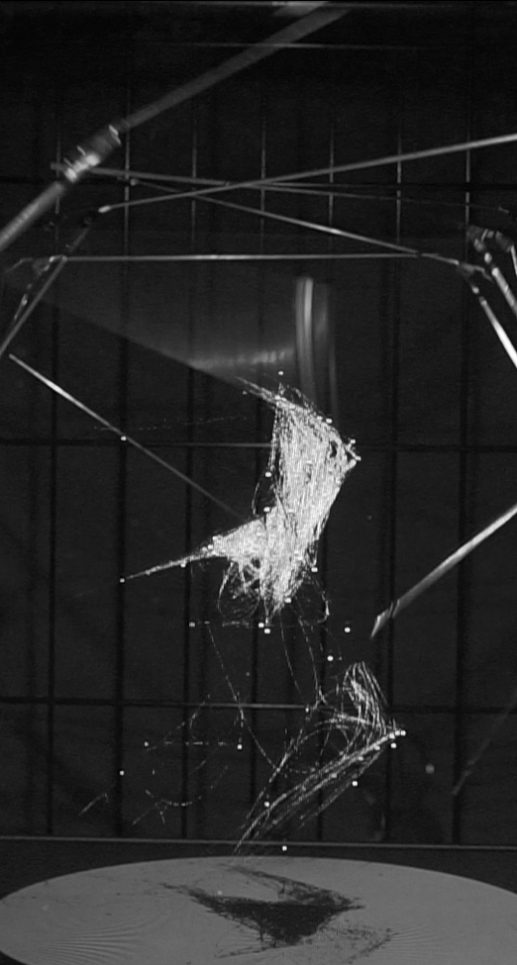
(In a gloomy space, or in total darkness, a hanging metal cage shelters the virtual and physical body of The Trained Particles Circus. The particles and their connections, dissected through a Pepper’s ghost in light and shadow, dance alongside an automaton which is composed of articulated rods and servos in an illusory common space. All its movements, images and sounds respond to the activity of a software entity submitted to interaction through attractors).
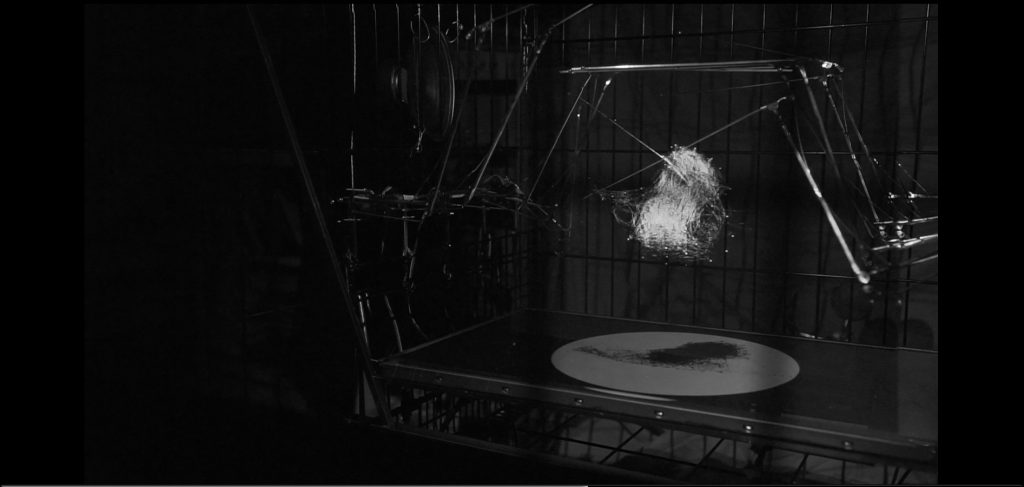
Creature vs. Puppet
Inside a cage there is something that needs to be locked up, because of its danger, its weirdness. -or maybe it’s better to say that something would like to protect himself from our threat. The particles are linked through a complex synthetic web which appears to have a life -or a non-life, insofar we refer to it as an autonomous synthetic creature or as a digital puppet. As an organism that develops adaptively in a medium governed by its own physical and generative laws, it turns out to be disturbingly organic. But its digital genesis places it in a world not restricted to a natural environment, but to native digital evolutions or even to speculative theoretical approaches.
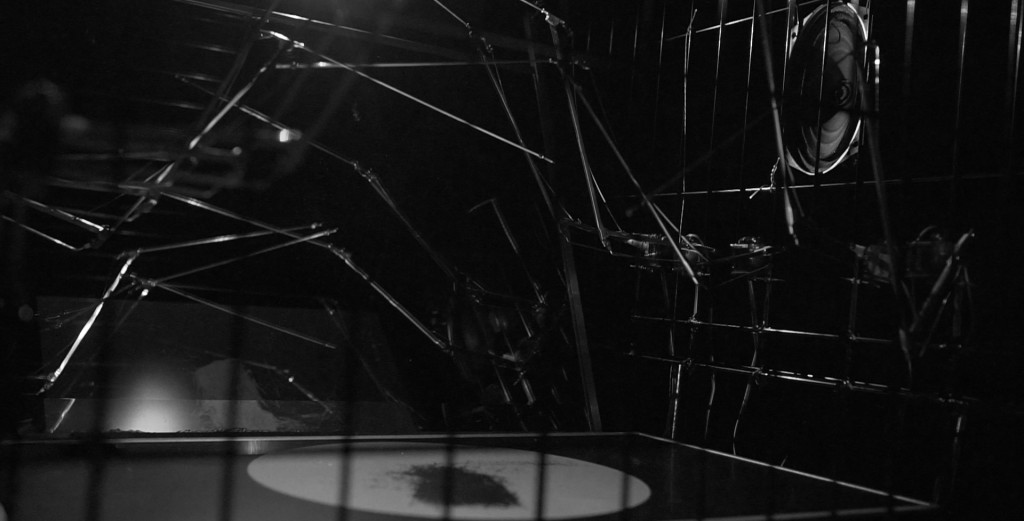
The ghost in the cage
The particles unfold dissected by software as particles-light and as particles-shadow. Separately, they have no shadow and the shadow has nothing that produces it. If nothing without shadow is real, what has it would be welcomed into the realm of the real. Even if it’s inside a cage. Just as an experiment arranges its elements to trigger a certain reaction, the Circus disposes its scene-sets to generate its magic: a light-object floating over its own shadow.
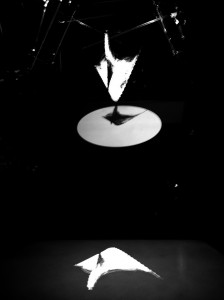
The particles constitute a precious object, subtle and fragile, mutant and ephemeral. Its image and movement respond to the ideality of the bodiless bits in the perfect abstraction of the code, where there is no friction, no noise, no wear. It’s the non-place of a Pepper´s ghost and the no-time of the machine. However, this virtual space-time co-inhabits with an automaton whose mechanical essence reveals it related to another different physics. It is the physics of engine noise, the friction of its articulated mechanisms, the wear of time, the exhaustion of work and the possibility of error and collapse. Its movement accompanies the elegant particles, scratching them without touching them, seeming to sew and undo the tangle of the synthetic fabric from its mechanical nature. And although both systems are fed with the same data and share the illusion of a real encounter, they are separated by an invisible border.
Their dialogue is the work.